
Search Atlanta Voter Registration
The official Georgia My Voter Page, often called MVP, is the first stop for an Atlanta voter checking a current record. It is an authenticated self-service system, not a directory that lets anyone browse names. Select Fulton for most Atlanta registrations or DeKalb when the registered address lies in the eastern part of the city. All four identity fields are required.
| Lookup field | Input | Required | How to enter it |
|---|---|---|---|
| First Initial | Text | Yes | First letter of the voter's first name |
| Last Name | Text | Yes | Name used on the registration |
| County | Dropdown | Yes | All 159 counties, including Fulton and DeKalb |
| Date of Birth | Date fields | Yes | Used to authenticate the voter |
The MVP login screen displays the fields used for an Atlanta voter registration search.
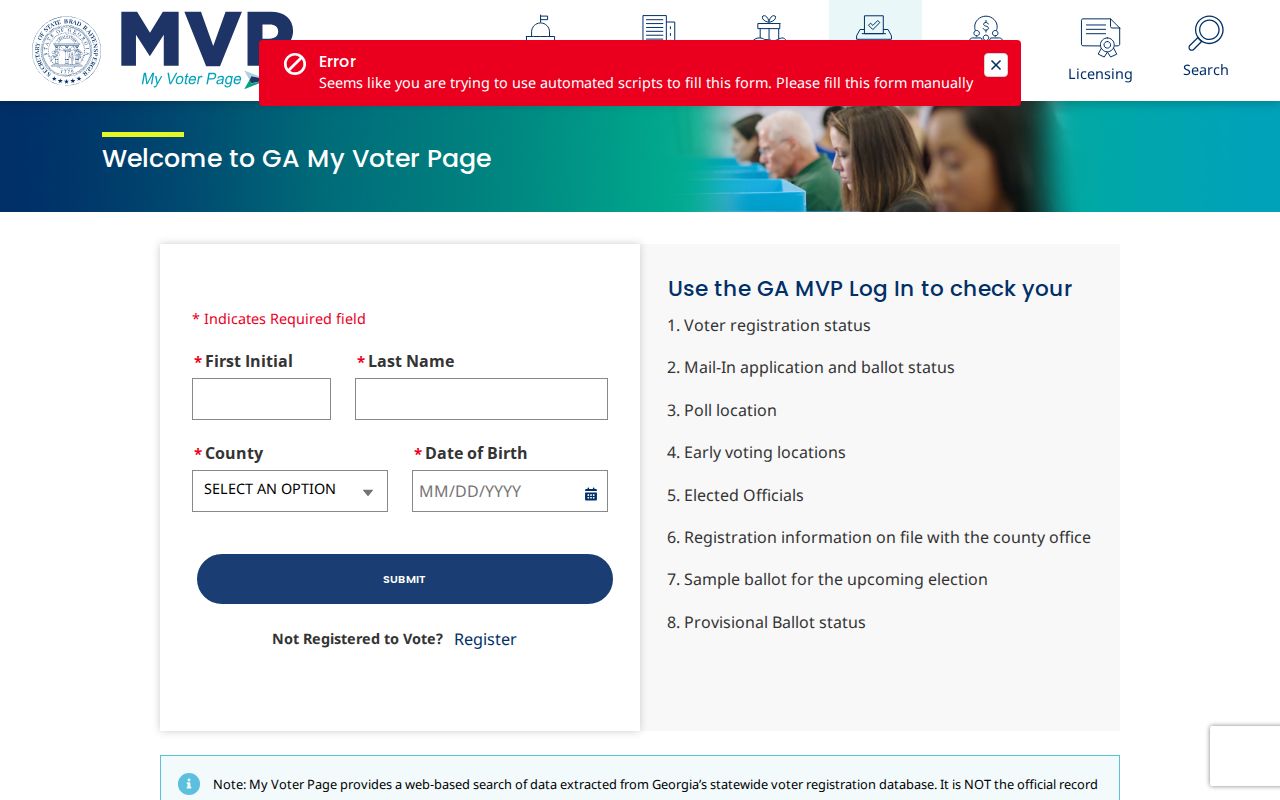
The request for a birth date confirms why MVP is not a public name index. If it finds no match, recheck the spelling, birth date, and county before contacting a registrar.
Atlanta Voter Lookup Results
A successful match returns more than a yes-or-no status. MVP can display the voter's current registration information, assigned polling place, elected districts, absentee-ballot status, and a sample ballot. Those details let a voter check whether an address update reached the right county and precinct before an election.
Polling and ballot details can change with district lines, precinct assignments, election schedules, or an absentee application. Treat the live result as the current administrative view. State guidance says a voter who has not received a precinct card within three to four weeks should contact the county office.
A mismatch may come from a recent move, a name change, a county-boundary mistake, or data that has not yet reached the displayed record. Save the exact name and address used on the registration before calling. The registrar can then check the county file without relying on a loose name match. For Atlanta addresses near the Fulton-DeKalb line, confirming the parcel or residence county prevents a referral to the wrong elections office.
Is MVP proof of another person's registration? No. It authenticates a voter with identifying facts and serves that voter. A public list request is the proper route for public voter-roll data.
Fields in Georgia Voter Records
Georgia election files separate public voter information from data used to register and authenticate a person. O.C.G.A. § 21-2-225 generally opens voter-registration records for inspection while protecting specified confidential data. The public list and authenticated view are not the same product.
| Name | A public voter-list field |
|---|---|
| Residence address | Generally public, except for VoteSafe and other protected voters |
| County, precinct, districts | Election fields personalized through MVP |
| Registration status and date | Maintained in the file; status appears to the authenticated voter |
| Participation history | May identify elections in which a voter took part, never ballot choices |
| Party | Georgia does not register voters by political party |
| Polling place and sample ballot | Personalized through MVP for an election |
Confidential under Georgia law. Social Security and driver's-license data are not public voter-list content. A full birth date should not be republished as a directory field, and a protected residence stays shielded under O.C.G.A. §§ 21-2-225 and 21-2-226.
A voter ID number is an administrative identifier, not a free-form personal identifier for republication. Mailing addresses may be kept where applicable, but release depends on election law and the supplied file layout.
Atlanta Voters Have No Party Registration
Georgia does not register voters by party. An Atlanta voter may choose a party ballot in a primary, but that act does not create permanent party affiliation in the registration record. A participation field may reflect that an election occurred and that the voter took part. It never reveals the candidates or questions selected on the secret ballot.
This distinction prevents a common error when reading voter records. A primary-history entry is not proof of a person's current beliefs, membership, or later vote. Use election history only for the limited fact it records.
Fulton Elections Handles Atlanta Records
Fulton County Registration and Elections administers local registrations, polling locations, absentee ballots, and list maintenance for most of Atlanta. Its general department line is 404-612-7020, and its registration service line is 404-612-3816. The office is the fallback for a wrong address, inactive record, precinct-card delay, or a question that MVP cannot resolve.
The county elections page groups those voter services with local contacts.
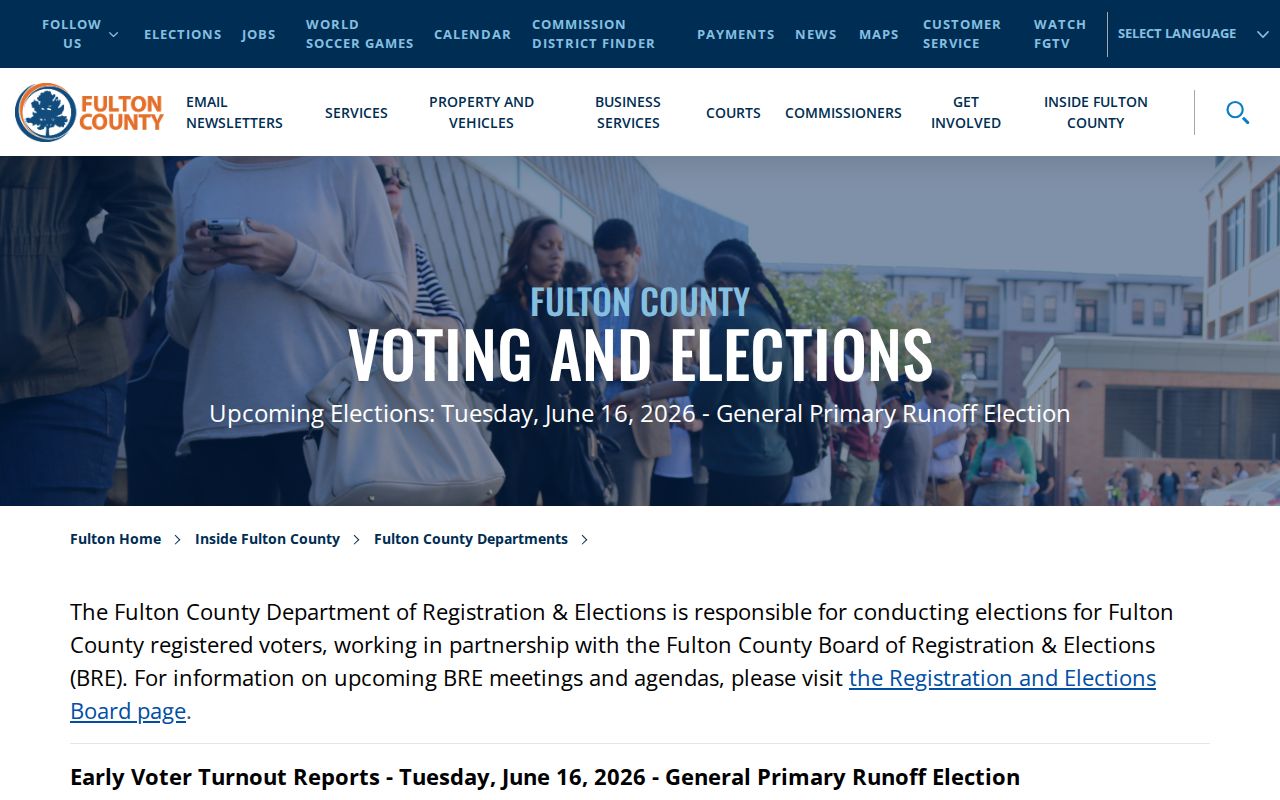
The page is also the right place to recheck a phone number because election contacts can change. A resident in the DeKalb part of Atlanta should work with the DeKalb registrar instead.
Note: The Atlanta mailing label does not decide the registrar; use the county tied to the registered residence.
Atlanta Voter Status Needs Context
Active, inactive, and cancelled do not mean the same thing. Georgia list-maintenance procedures can move a voter to inactive status after official confirmation steps. A single missed election does not by itself cancel the record. Cancellation follows Georgia election law and federal National Voter Registration Act safeguards.
An inactive result calls for verification, not an assumption that the person cannot vote. Review the record in MVP, then ask the county registrar what action is needed. A voter who moved should follow the state's registration and address-update guidance, with care to select the county that now holds the residence.
Request Georgia Voter Registration Lists
MVP is not the route for a bulk file. The Secretary of State's Open Records page points requesters to the purchase channel for voter lists, license rosters, and corporation lists. O.C.G.A. § 21-2-226 governs copies of electors lists and related conditions. Exact products, current prices, and file choices were not exposed in the research capture, so verify them in the live purchase workflow before ordering.
- Choose the purchase route for voter lists, not the MVP login.
- Identify the contact or organization, email, phone, address, and desired geography or list type.
- Select history or delivery options only when the current form offers them, then review its price and payment terms.
- Keep the supplied field layout and restrictions with the delivered file so each column is read correctly.
The Secretary of State request screen distinguishes list purchases from ordinary agency requests.
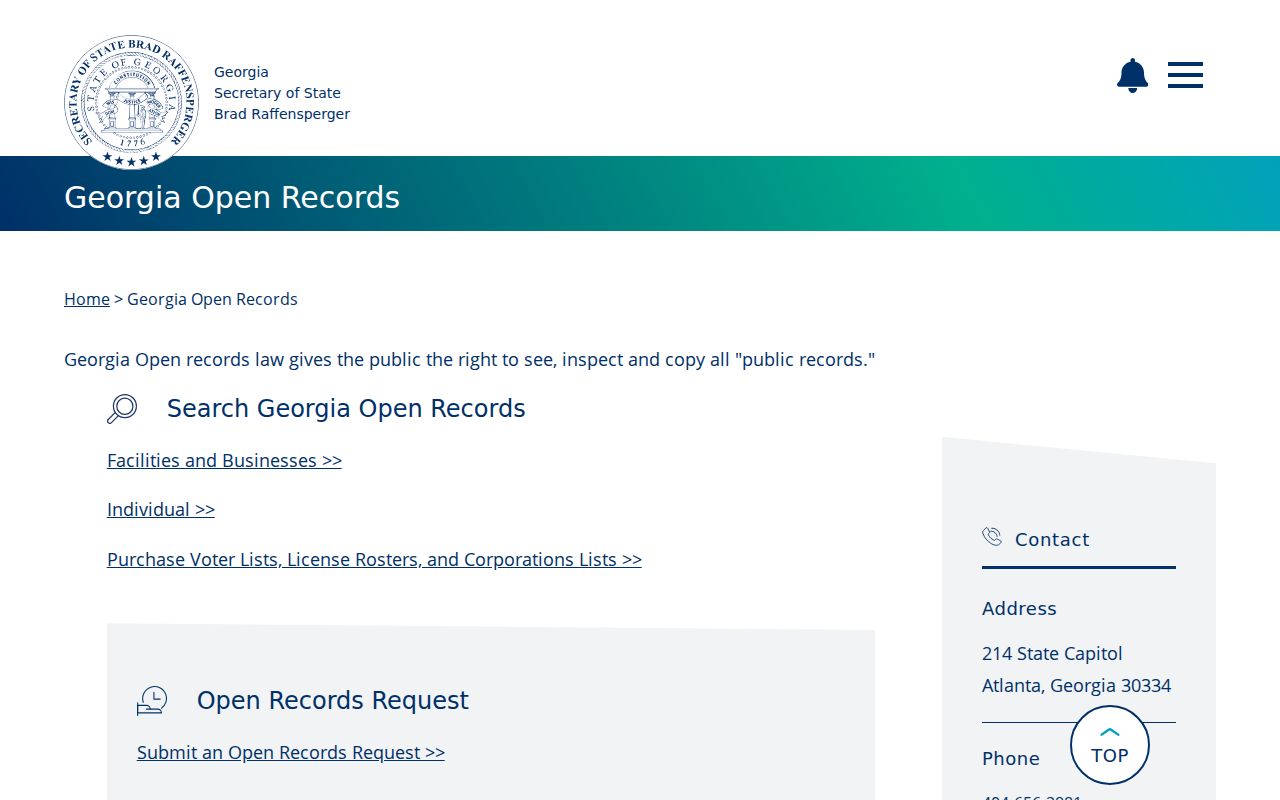
That distinction matters because an open-record request does not force the state to create a custom compilation. Ask for an existing product or layout. General procedure belongs with Atlanta public records requests.
VoteSafe Shields Atlanta Voter Addresses
The public nature of ordinary names and addresses has a vital exception. Georgia VoteSafe protects the residence address of a qualifying registered voter who is under a protective or restraining order or lives in a family-violence shelter. The voter can contact Secretary of State Elections at 404-656-2871 or the county registrar.
Georgia's broader Safe at Home program supplies a substitute address and mail service for eligible survivors under O.C.G.A. §§ 50-18-150 et seq. Neither protection should be bypassed by combining voter rolls with other sources. A missing or substitute address can reflect a legal safety step, not a flawed record.
Note: Never infer or publish a protected residence from a mismatch between a voter list and another source.
Historical Atlanta Election Records
Current MVP results do not answer historical questions. Old Atlanta poll books, registration registers, precinct material, and election papers may survive through Georgia Archives finding aids, Fulton records, library microfilm, manuscripts, city documents, and newspapers. No official consolidated run of Fulton poll-book or registration-register coverage years was found, so do not assume a complete date span.
Jurisdiction changes add a layer. Fulton County was created from DeKalb County in 1853, and Atlanta sits near the modern boundary. Earlier research may point to DeKalb or state records. Milton and Campbell counties merged into Fulton in 1932, which can affect older county election material beyond central Atlanta.
Start with a known year, precinct, ward, address, or candidate. Ask the archive or library for that record series. A newspaper can add context, but the custodian's poll book or register is stronger proof of an official entry.
Historical voter rolls can help place an adult at an address during a narrow period, yet an absence proves little. Eligibility rules changed, records may be incomplete, and surviving books may cover only one ward or election. Compare the entry with a city directory, census schedule, deed, or vital record before deciding that two matching names refer to the same Atlanta resident. Record the archive name, collection title, box or volume, page, election date, and precinct so another researcher can retrace the finding.
Use Atlanta Voter Records Lawfully
Public access is not permission to threaten, monitor, impersonate, or harass a voter. Georgia stalking and harassing-communications laws include O.C.G.A. §§ 16-5-90 and 16-11-39.1. Protected addresses, voter identifiers, and confidential registration data have their own limits. Follow the terms supplied with a voter file and keep ballot participation separate from ballot choice.
Use the narrowest needed record. Confirm civic or historical facts without republishing birth dates, administrative ID numbers, protected addresses, or a person's inferred political views.
Scammers may use public details to pose as election staff. Verify any call through an independently found number on an official government domain. Report an immediate threat to law enforcement and direct a record concern to Fulton Elections or Secretary of State Elections.